Diagnose OpenRouter capacity at the account, key and eligible endpoint levels. Use credit evidence, rate headers and routing constraints to decide whether work should wait or stop.
How OpenRouter limits work
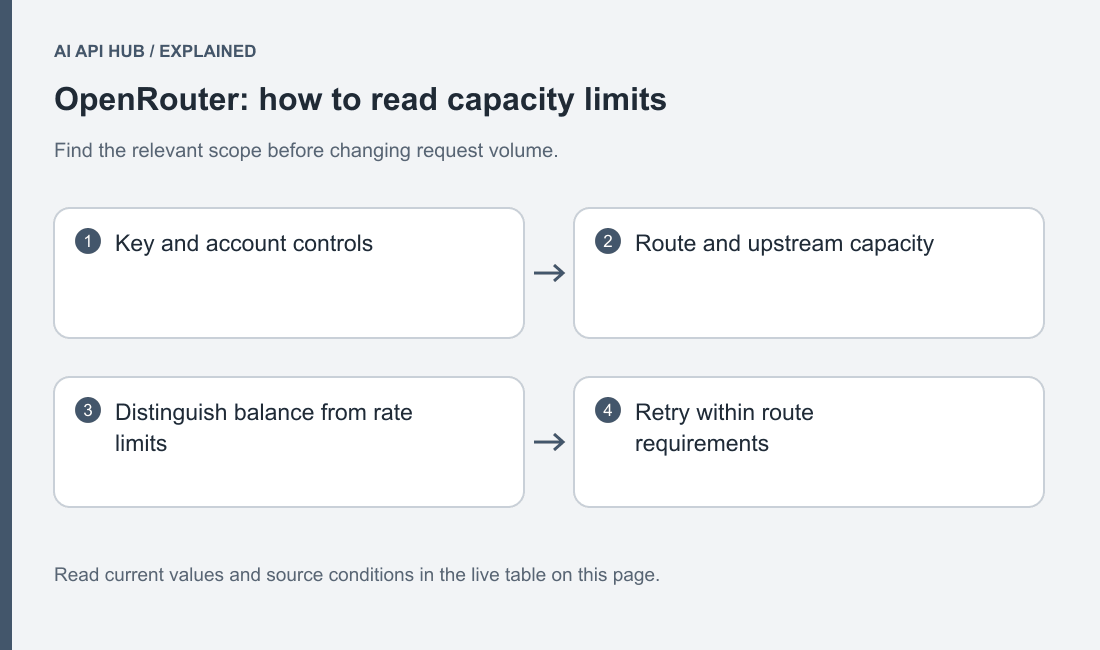
OpenRouter separates credit limits from request-rate limits and states that additional accounts or keys do not expand globally governed capacity. Official documentation.
Map the application’s producers of traffic before adding workers. A background batch, interactive feature and evaluation harness can create a shared pattern that individual logs do not show. Keep the workload owner and key identity in safe metadata so the account view can be reconciled with application behavior.
A routing layer adds another source of eligibility constraints. The model can be known while no endpoint satisfies the required parameters, account preferences or price conditions. Treat that result as a request-policy outcome, not automatically a sign that the entire service is down.
Keep capacity and spending in separate operational views. A funded account can still encounter request throttling, while a quiet application can reach a key or workspace spending boundary. The correct response depends on which condition the provider actually reports.
Limits by tier and model
Published limits have not yet been verified for this selection. Check the official limits documentation and your account console.
Last verified · Source ↗
Read each row’s scope and offer conditions. A free-route allowance cannot be inferred from a paid model’s status, and a per-key credit boundary should not be described as a model throughput limit. Preserve those distinctions when creating dashboards and alert messages.
Inspect the selected endpoint if a model has several serving options. An aggregate catalog view is useful for discovery, but the route that handled the request supplies the evidence relevant to a particular operational failure. Keep the returned identity and routing configuration with the timestamp.
How to move up a tier
Start by identifying whether the desired change concerns credit, free-route eligibility, workspace budget or endpoint capacity. There is no useful universal upgrade instruction for all of those conditions. Inspect the account-visible controls and the source linked from the applicable live row.
Prepare a workload description when seeking additional capacity: task shape, expected burst, acceptable queue delay and fallback requirements. If the application can tolerate delayed results, evaluate the asynchronous route separately. If it requires an interactive response, measure the user-visible deadline instead of treating aggregate throughput as the only goal.
After changing an account control, verify that the intended boundary still exists. A quick increase can resolve the immediate rejection while removing the experiment’s budget protection. Record who changed the setting and why, then observe the actual workload before raising parallelism again.
Reading limit headers and 429 responses
Rate errors expose X-RateLimit metadata where applicable, and the error guide describes Retry-After for temporary failures. Official documentation.
Retain the actual values in request diagnostics instead of hardcoding reset assumptions into prose or application behavior. When timing is absent, use a bounded conservative policy and inspect repeated failures. Never assume that a delay will repair a credit or permission boundary.
For credit diagnosis, inspect the current key view and its remaining allowance without printing the secret. Keep the response scoped to the authorized operator. A public application should expose a useful unavailable state rather than returning the account’s raw billing details to every end user.
Retry strategy the provider recommends
Honor supplied retry timing and keep a single retry owner. The starter disables library retries so one invocation is easy to inspect; a production worker can add a policy after distinguishing temporary conditions from invalid input and account failures.
Define an attempt cap and a task deadline. A request that eventually succeeds after the user’s need has expired may still be wasted work. Keep the final state explicit and prevent a recovered job from repeating a downstream side effect that already occurred before the failure was detected.
Model fallback lists try candidates in a stated order when the primary route cannot complete. Official documentation.
Use only pre-evaluated fallbacks that satisfy the task’s mandatory conditions. A successful response from a different model is operational recovery only if it still meets the application contract. Preserve the resolved model and cost categories when recording the recovered task.
Batch/async options that bypass limits
OpenRouter now documents a Batch API with a distinct asynchronous submission and retrieval lifecycle. Official documentation.
Check supported models and current batch conditions before planning offline work. The presence of a batch route does not justify calling it unlimited or assuming every synchronous feature transfers. Start with a small job, preserve custom request identities and reconcile failed rows alongside successful outputs.
Build visible queued, processing and completed states into the caller. If delayed results do not fit the product, the batch path does not solve its interactive capacity requirement. Compare the full workflow, including result retrieval and validation, before moving an existing task.
Connect the chosen processing mode to OpenRouter workload costs and route-aware error handling.
Use the AI API cost calculator to turn the model and workload you are considering into an estimate.
Last verified · Source ↗
Frequently asked questions
Will more keys multiply available request capacity?
Does a funded account eliminate rate errors?
Why can a known model have no eligible route?
Should a credit failure enter exponential backoff?
Can any model serve as a fallback?
Is OpenRouter batch processing unlimited?
Sources
- OpenRouter quickstart ↗
- Models and pricing schema ↗
- Authentication ↗
- Credit and rate limits ↗
- Errors and debugging ↗
- Provider routing ↗
- Free model variants ↗
- Free router ↗
- Workspace budgets ↗
- Prompt caching ↗
- BYOK ↗
- Provider logging ↗
- Batch quickstart ↗
- Latest aliases ↗
Last verified · Source ↗