OpenRouter adds a model catalog and routing relationship between your application and serving endpoints. A direct integration connects to the selected provider’s own API account and request interface.
Definition with a live example
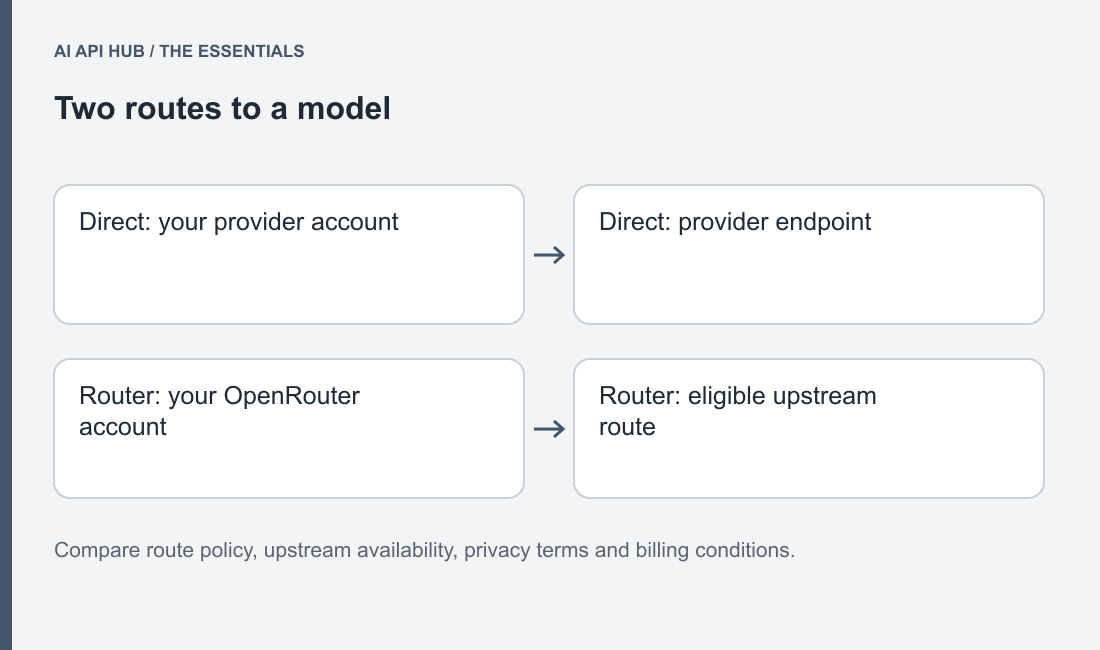
The choice begins with the operating path. In a direct integration, the application manages the provider credential and endpoint explicitly. Through OpenRouter, it authenticates to the routing service and selects a catalog route subject to routing configuration. The underlying model family can be related while the account, billing and diagnostic path differ.
OpenRouter exposes provider-selection controls and model routing metadata, allowing eligibility to depend on capabilities and request requirements. Official documentation.
This table compares each provider’s lowest documented baseline input-price model. Baseline prices use standard or short-context conditions and exclude separate free-tier and off-peak rows when paid standard rates exist. The full pricing reference preserves all documented conditions.
| Attribute | inclusionAI: Ling 3.0 Flash VL (free) | gpt-5.6-luna |
|---|---|---|
| Provider | OpenRouter | OpenAI |
| Official identifier | inclusionai/ling-3.0-flash-vl:free | gpt-5.6-luna |
| Input USD / 1M | Free | $0.2 |
| Output USD / 1M | Free | $1.2 |
| Cached input USD / 1M | Not documented | $0.02 |
| Context tokens | 262,144 | 1,050,000 |
| Maximum output tokens | 32,768 | 128,000 |
| Modalities | text, image, video | text |
| OpenAI-compatible endpoint | Yes | Yes |
| SDK languages | Python, JavaScript | Python, JavaScript, Go, Java, C# |
| Reference | inclusionAI: Ling 3.0 Flash VL (free) | gpt-5.6-luna |
Last verified · Source ↗
The live comparison helps inspect documented attributes, but it cannot determine which path produces the best application result without a workload. Define the required endpoint features, output contract and account controls first. Then evaluate a small set of actual routes using the same safe fixtures.
A direct request can be attractive when the application depends on a provider’s native interface or account workflow. A router can be attractive when the application needs a catalog, multiple serving options or an explicit fallback arrangement. Neither description is a universal recommendation: the right choice follows the requirements that remain mandatory when a route fails.
Keep the model and host identity in the decision record. A comparison named after the model alone can hide a different serving endpoint or alias target. Retain requested and returned identities where available so observed quality and usage can be attributed to the path actually tested.
How it affects cost / limits / results
For cost, compare applicable charge categories and account arrangements. A direct price row and a router catalog amount may describe different routing or service conditions. Keep units, optional features and any maximum-price policy visible. A nominally cheaper input rate does not settle a response-heavy or multi-stage workload.
BYOK allows upstream provider credentials to be used through OpenRouter under separate fee and fallback rules. Official documentation.
If using that arrangement, keep upstream inference spending and routing-account charges separate until reconciled. Do not assume bringing a key removes every routing-service condition. Document which account pays for the selected operation and whether fallback can change that relationship.
Use the workload calculator with identical accepted-output assumptions for each candidate. Include extra calls needed for repair and preserve any category outside the tool’s token estimate.
For reliability, specify allowed variation. A fallback to another endpoint or model is useful only if it still meets the application’s feature, data and output requirements. Test each permitted candidate and keep downstream side effects safe to reconcile after retries. An available fluent answer is not automatically an accepted result.
For development, begin from the native minimum request for each path. A compatible SDK can reduce code changes while hiding optional-field differences. Keep a feature checklist and test the fields that the application actually depends on. Preserve the response parser and error-handling contract with the request implementation.
For account operations, decide where owners will inspect spending and diagnose failures. A router adds a relationship that can simplify some workflows and complicate others. Keep key ownership, budget boundaries and the source of a specific error clear enough that an operator can act without guessing which dashboard applies.
Provider differences
OpenRouter provides routing controls and provider-policy information. Inspect eligibility and the serving provider’s applicable terms before sending application data.
OpenAI direct uses its own account and Responses quickstart. Verify native features and project controls when they are central to the integration.
Anthropic direct documents Messages and its SDK path. Compare the actual required content blocks and tools with the route you intend to use.
These examples should be evaluated as APIs. Do not substitute the behavior or subscription terms of another product for the programmatic service. Use the request interface, account and model relevant to the application you are building.
If the application already has a direct integration, preserve its passing fixture set before adding a router. If it begins with a router, keep concrete evaluated routes available when investigating a change. Both paths benefit from an explicit record of what was requested, what served it and what passed validation.
Common mistakes
Do not assume compatible means identical. A required parameter can be unsupported or treated differently by a serving endpoint. Use explicit parameter-support controls where appropriate and validate the resulting output.
Do not treat a fallback as harmless variation without evaluating it. A different model can change output structure, grounding and cost. Define the allowed candidate set and inspect the resolved identity.
Do not compare a direct account’s offer with an unrelated routed model’s price as though they were the same entitlement. Keep account, host and offer scope attached to each scenario.
Do not infer a single universal provider data policy from the router’s name. Inspect the serving endpoint’s terms and the account routing preferences relevant to the request.
Do not choose solely on a headline markup or model rate. Evaluate the complete accepted task, required native features, operating controls and maintenance work. Keep the unresolved tradeoffs visible instead of claiming a universal winner.
Last verified · Source ↗
Frequently asked questions
Is OpenRouter a direct account with every model developer?
Does a compatible client guarantee all features match?
Does BYOK remove all router-specific billing rules?
When is a fallback acceptable?
What should a fair cost comparison preserve?
What should I record after evaluating a route?
Sources
- OpenRouter routing ↗
- OpenRouter BYOK ↗
- OpenRouter provider policies ↗
- OpenAI quickstart ↗
- Claude quickstart ↗
Last verified · Source ↗