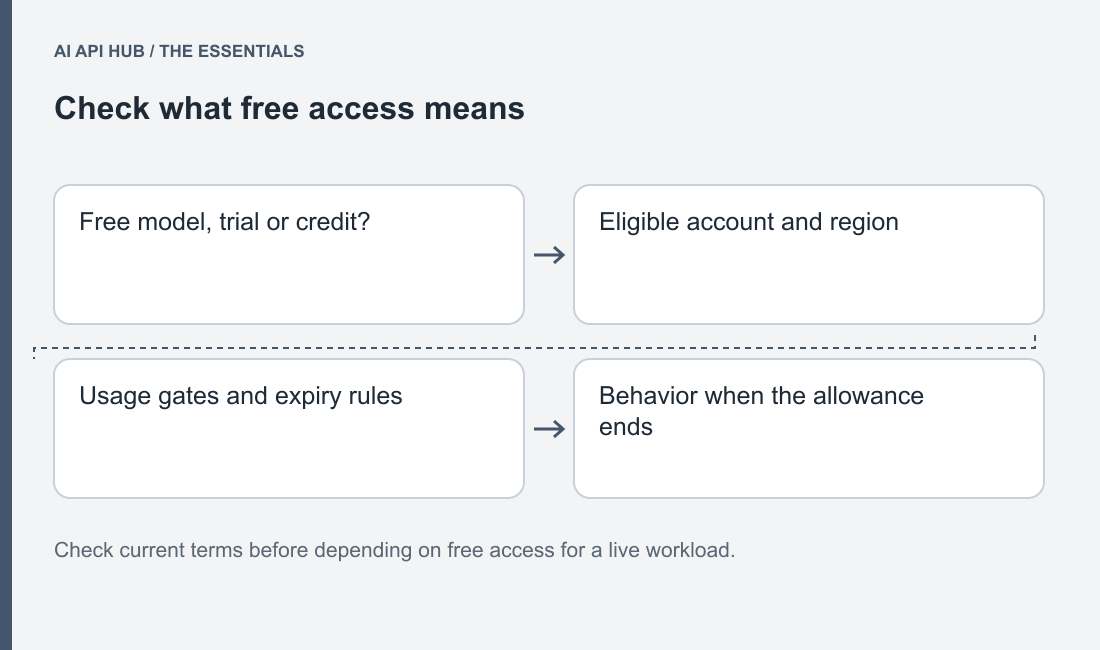
A free API offer describes eligible work under specific account and model conditions. Identify the offer type, its limits and its ending condition before building a prototype around it.
Definition with a live example
A credit grant covers eligible charges until its balance or validity ends. A free quota can attach to a particular model and operation. A free model route identifies an inference category offered without its ordinary price, but can still have request and availability conditions. These forms should not be collapsed into a single promise of unlimited free access.
| Condition | Verified details |
|---|---|
| Current terms | The official model catalog lists models with zero input and output token rates. Availability and free-model request limits can change. |
| Eligible models | inclusionai/ling-3.0-flash-vl:free, nex-agi/nex-n2.5-mini:free, nex-agi/nex-n2.5-pro:free, inclusionai/ling-3.0-flash-sante:free, inclusionai/ling-3.0-flash-fin:free, dots-studio/dots-3-note-preview:free, liquid/lfm-2.5-2.6b:free, nvidia/nemotron-3.5-lightning:free, thinkingmachines/inkling-small:free, poolside/laguna-s-2.1:free, thinkingmachines/inkling:free, poolside/laguna-xs-2.1:free, cohere/north-mini-code:free, nvidia/nemotron-3.5-content-safety:free, nvidia/nemotron-3-ultra-550b-a55b:free, nvidia/nemotron-3-nano-omni-30b-a3b-reasoning:free, google/gemma-4-26b-a4b-it:free, google/gemma-4-31b-it:free, google/lyria-3-pro-preview, google/lyria-3-clip-preview, nvidia/nemotron-3-super-120b-a12b:free, openrouter/free |
Last verified · Source ↗
The live offer block keeps current evidence and conditions together. Read its source, verification date and scope before assuming it applies to the account you will use. A signup page, old tutorial or successful demonstration does not prove that the next request remains covered.
Write down what the offer actually establishes: eligible account, selected model, covered operation, remaining entitlement and expiry or stop condition. When one field is unknown, retain it as unknown. An offer with incomplete evidence should not be used as the sole operating basis for a recurring job.
A free-only product promise needs a stopping behavior. Decide what the application shows when work cannot continue and what happens to queued tasks. A deliberately unavailable state is better than silently moving to a paid route that the operator did not plan.
How it affects cost / limits / results
Use a safe evaluation fixture that makes each request informative. Include an ordinary case and a case with missing or conflicting evidence. Inspect the output before generating a large sample. This turns limited access into an investigation of suitability instead of a collection of demonstrations.
Keep the underlying paid workload estimate even when a grant covers it. The estimate describes the application’s continuing economics after an offer ends. Preserve ordinary and demanding cases, plus any repair calls and optional hosted features the tool cannot count.
Use the API cost calculator for that paid fallback and document the stop-or-pay decision. An expiring credit should not become the reason an application has no plan for its next month of operation.
Capacity is separate from the offer balance. A free request can be throttled while quota remains, and a well-paced request can be blocked after the offer ends. The error code and account view determine which condition applies. Do not repair a rate problem by changing the billing mode without evidence.
Evaluate data-handling terms and required capabilities before sending application material. A zero listed inference price does not establish that the serving endpoint meets the product’s privacy or output requirements. Use synthetic or safely redacted fixtures until those conditions are understood.
Close the experiment deliberately. Save the observed usage and accepted outcomes, stop abandoned schedules and retire unneeded credentials. A free prototype can otherwise become an invisible background dependency or inherit a changed paid configuration later.
Provider differences
OpenRouter distinguishes named free variants from a router that selects eligible free candidates. Preserve the actual returned model if you use the router for evaluation.
Alibaba Model Studio documents model-specific free quotas with expiry and excluded operations. A snapshot and a current alias can require separate offer checks.
Google Gemini publishes free and paid conditions in the pricing reference. Verify the account, model and enabled feature before assigning a request to an offer.
These examples have different stopping and accounting behavior. Do not copy one provider’s conditions into another provider’s guide. Preserve the source field that supports the offer and verify it in the account that will make the call.
When comparing alternatives, reuse the application fixture but recheck endpoint, credential, model identity, policy and capacity. A compatible client can reduce code changes while leaving every one of those operating conditions different.
Common mistakes
Do not treat a blank price or missing offer record as free. Unknown evidence needs investigation and should remain visible to the person making the decision.
Do not assume inactivity pauses expiration. Read the applicable offer terms and set a reminder in the application’s operating process when a validity boundary matters. The reference date is not an extension of provider eligibility.
Do not move a real-time prototype to batch while assuming the same free offer covers it. Check the covered operations explicitly and include any storage or processing service in the cost plan.
Do not let a fallback change the financial promise. A free-only flow should stop unless the permitted paid alternative is selected and budgeted. Keep the allowed route set visible in configuration.
Do not evaluate a changing free router as if every result came from one fixed model. Retain the resolved identity and separate outcomes when comparing quality or repeatability.
Last verified · Source ↗
Frequently asked questions
Are credits and a free model route the same offer?
Does a successful first call prove future calls are free?
Should I estimate paid usage during a trial?
Can rate limits apply while free quota remains?
What should a free-only flow do when no route remains?
What should I preserve from a free experiment?
Sources
Last verified · Source ↗